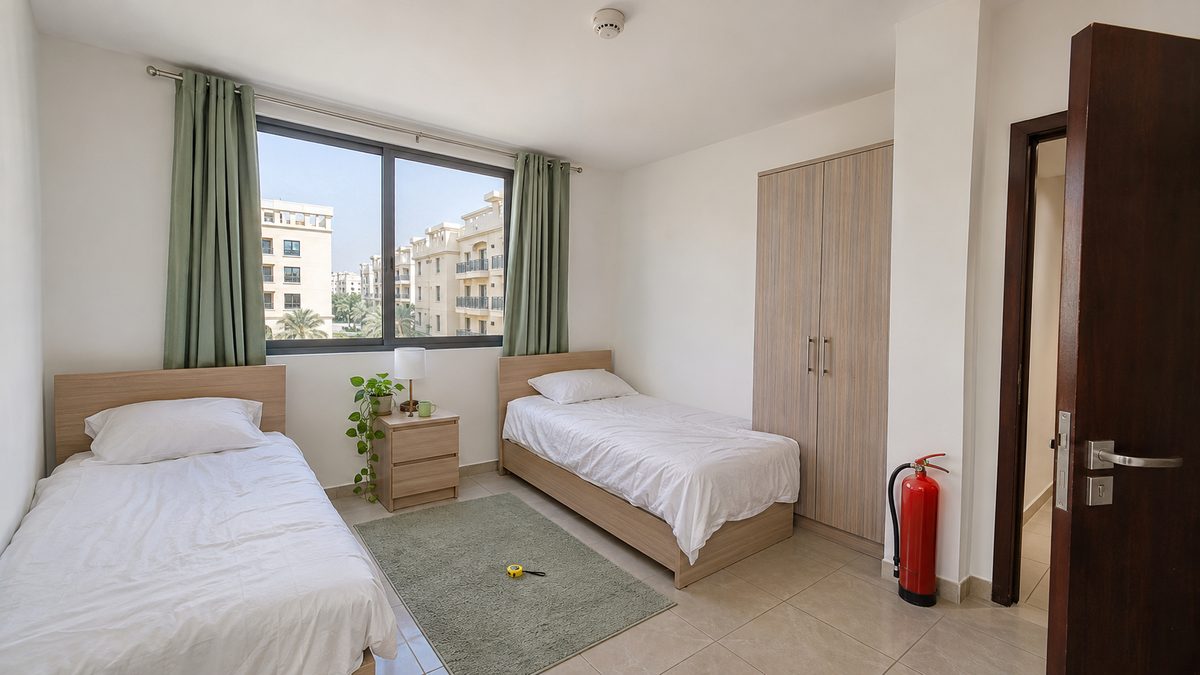
Renting Out Rooms in Dubai? The New Shared Housing Rules Explained
If you let a villa or apartment to several tenants in Dubai, the clock is running. You have until September 2027 to bring it in line with the new shared housing rules, and they may reduce how many people you can legally house.
Law No. 4 of 2026 took effect on 8 September 2026, and on 7 October Dubai Municipality published the Planning and Building Requirements Guide that sets the building standards. Landlords who sort out their layout, fire safety and permit early keep their rental income. Those who leave it late risk a rushed refit, or a property they can no longer let this way.
Shared housing is now only allowed in 44+ permitted areas, with at least 5 m² of bedroom space per person, proper shared facilities, Civil Defence and CCTV compliance, and a permit through the Build in Dubai platform. Existing operators have one year from 8 September 2026 to regularise.
This affects you if:
- You let rooms or bed spaces in a villa or apartment to unrelated tenants
- Your property has added partitions, or rooms converted to bedrooms
- You manage a building with several shared units
- You're thinking of buying a property to run as shared housing
Only in permitted areas
Shared housing is only allowed in designated areas. More than 44 areas have been approved so far, and Dubai Municipality says more will be announced as they are approved. If your building is outside a permitted area, it cannot be licensed for shared housing, so check this first.
Collective labour accommodation is outside this law and stays under its own rules.
One category per building
Each existing building has to be assigned to one category: individual accommodation or family accommodation. The category decides which facilities and layouts apply, so it is the first decision to make.
The rule that changes the numbers: 5 m² per person
- At least 5 m² of bedroom space per person. This decides how many occupants a unit can legally hold.
- Kitchens and bathrooms sized to the number of occupants
- Dining, recreation, laundry and clothes-drying areas
- Everything designed in line with the Dubai Building Code
Reports also say family units need separate rooms. The practical result is that many units now let "per bed" will hold fewer people once the 5 m² rule is applied, and some partitioned layouts will have to be opened up. A good layout redesign can often win back capacity, for example by turning under-used space into compliant bedrooms instead of simply removing beds.
Find out how many tenants your property can legally hold
We measure the property, calculate the legal occupancy under the new rules and show you the best compliant layout before you spend anything on works. Free site visit, fixed-fee quote.
The permit route, step by step
- Confirm the building is in a permitted area and choose its category
- Survey the existing layout and calculate the allowed occupancy
- Fix fire safety: alarms, escape routes and fire separation, checked by Dubai Civil Defence
- Install compliant CCTV, checked by SIRA
- Apply for the shared housing permit, and later renew it, on the Build in Dubai platform
The one-year window is not an amnesty
The regularisation period gives existing operators time to comply. It does not excuse building violations, an unauthorised change of use, or anything that puts public safety at risk. Those must be corrected regardless. Illegal partitions, blocked escape routes and overloaded electrical installations are the usual problems.
How we help landlords
Most of the work is technical: measured surveys, occupancy calculations, revised layouts, fire safety upgrades and the drawings for any modification or change-of-use permit. We handle the full route: survey, layout redesign, Dubai Civil Defence approval, building modification permits and Dubai Municipality approvals. Doing it once, properly, costs less than a rejected application followed by a rushed refit.
Keep your rental income, and stay legal
Send us the area, property type and number of rooms. An engineer will tell you what needs to change and what it will cost.
Frequently asked questions
When did Dubai's shared housing law take effect?
Law No. 4 of 2026 took effect on 8 September 2026. Existing shared housing has one year from then to regularise. Dubai Municipality published its Planning and Building Requirements Guide on 7 October 2026.
What is the minimum bedroom size for shared housing in Dubai?
The guide sets a minimum of 5 square metres of bedroom space per person, alongside requirements for kitchens, bathrooms, dining, laundry and drying areas sized to the number of occupants.
Can I run shared housing anywhere in Dubai?
No. Shared housing is only allowed in permitted areas. More than 44 areas have been approved so far, and Dubai Municipality says more will be announced as they are approved. Collective labour accommodation is covered by separate rules.
Do I need a permit to use my building or villa for shared housing?
Yes. A building or villa needs a permit before it is used as shared housing. You apply and renew through the Build in Dubai platform, after fire safety and CCTV compliance have been checked with Dubai Civil Defence and SIRA.
Sources
Summarised from official announcements and published coverage. Always check the official text before making a compliance decision.